


What about Expiration Dates?
Expiration dates indicate the period a manufacturer guarantees full potency and safety under proper storage conditions—they do not necessarily mean a medication becomes ineffective or unsafe after that date. Studies from the U.S. Food and Drug Administration and Department of Defense (Shelf-Life Extension Program) tested thousands of medication lots and found that approximately 88% remained stable beyond expiration, with an average extension of over 5 years. Many solid medications, such as tablets and capsules, have been shown to remain effective 10–15+ years, and in some cases decades, when stored properly.
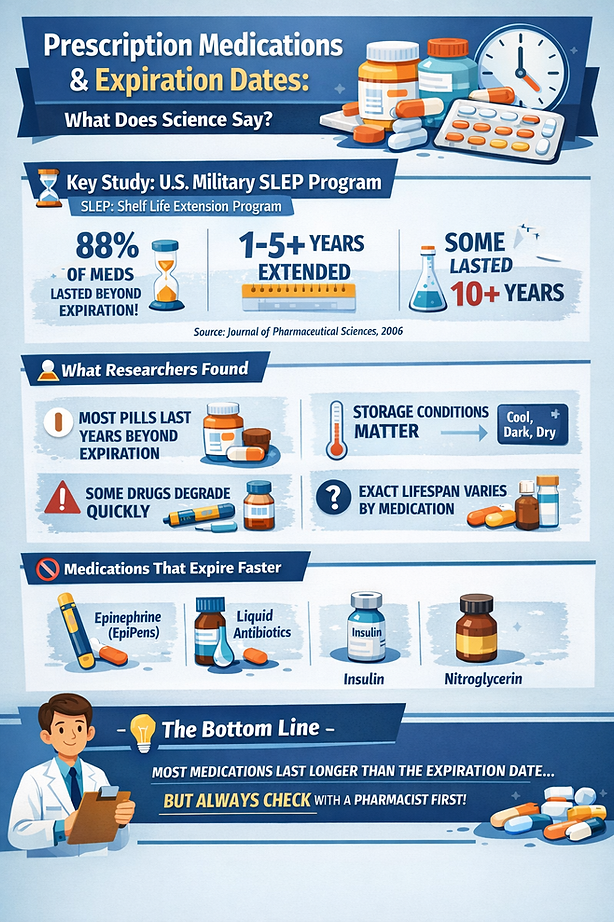
Stability depends heavily on storage conditions and medication type. Drugs kept in a cool, dry, dark environment and in original sealed containers last significantly longer. Solid oral medications are generally the most stable, while liquids, reconstituted antibiotics, insulin, epinephrine, and nitroglycerin degrade more quickly and should be replaced more conservatively. Do not use medications that show changes in color, smell, or texture, or that have been exposed to heat or moisture. Expired medications may have reduced effectiveness and should not replace professional medical care when available—use sound judgment, especially in serious or emergency situations.